Teachers Change the World One Child Embroidery Review
I see a lot of embroidery designs cross my workbench. Most are forgettable. Some are pretty. Then there are the ones that stop you mid-scroll because they carry a message that actually means something. Teachers Change the World One Child falls into that third category, and as someone who stitches for small business clients every week, I immediately started thinking about how this design could work on real merchandise, not just a hoop test.
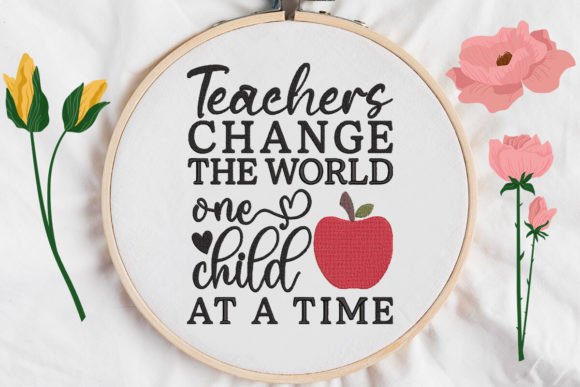
Right out of the gate, the Teachers Change the World One Child design has a warm, handcrafted feel that bridges the gap between sentimental and professional. It reads as friendly without being childish, bold without shouting. The phrasing is concise enough to live on a patch or a chest logo, yet emotive enough to carry weight on a tote bag or framed hoop art. For a small business owner, that balance is gold. You want a machine embroidery design that connects with customers emotionally but still looks crisp and intentional on a finished product.
First Impressions and Visual Personality
When I first previewed Teachers Change the World One Child, I got a sense of classic, almost chalkboard-inspired charm. The lettering style feels rooted in the School category, but it does not scream classroom-only. That is important. If the design were too juvenile, it would pigeonhole the embroidery file into teacher appreciation gifts alone. Instead, the composition feels versatile enough for bookshop merch, tutoring service uniforms, library volunteer aprons, literacy nonprofit branding, and boutique product lines that celebrate education.
The overall personality leans toward a modern rustic aesthetic. It has a handmade quality that would feel right at home on a natural canvas tote, a soft cotton tee, or a denim jacket. It is not overly decorative or filled with excessive flourishes, which tells me the digitizer likely prioritized clean stitch paths and manageable stitch density. That matters enormously when you are stitching at production scale.
Small Business Merchandise Potential
Let us talk about where this design truly shines. I have worked with bakeries that wanted aprons embroidered with something more meaningful than their logo. I have helped Etsy sellers create branded merchandise that tells a story. I have watched a single well-chosen embroidery design become the signature mark of a handmade product line. Teachers Change the World One Child fits into that strategy beautifully.
For a tutoring center or educational consultant, this design works as a chest logo accent on polo shirts and staff uniforms. It is personal without being overly casual. Stitched onto a cap front, it creates an approachable, mission-driven look. On a tote bag, it becomes a conversation starter. Picture a small bookstore using this on canvas totes sold at the counter. The message aligns with their brand identity, and the embroidery quality elevates the perceived value of the finished product.
For handmade businesses, the embroidered patch possibility is especially compelling. A well-produced patch version of Teachers Change the World One Child could be sewn onto jean jackets, added to backpacks, or sold as a standalone product. Patches are having a major moment in small business merch right now. They are low overhead, easy to ship, and customers love the tactile feel of a quality patch. If you are selling digital embroidery file downloads, make sure your buyers understand whether this design is optimized for patch creation. The lettering size and column widths will determine how well it reduces to patch scale.
Where to Use It Carefully
No design is flawless for every application, and being honest about limitations is part of a real review. With Teachers Change the World One Child, the primary concern is the lettering. Any embroidery design with text demands extra scrutiny. If the phrase is rendered in a script or thin serif font, shrinking it below a certain size for cap embroidery or small patch use could cause the letters to close up or lose definition. I always recommend testing the design at actual production size before committing to a bulk run.
Curved surfaces like cap fronts and sleeve hems can distort lettering if the design is not specifically digitized for that curve. If you plan to use this on headwear, confirm the hoop size and placement alignment with your cap frame. The same goes for textured fabric like waffle weave towels or heavy canvas. A design with moderate to high stitch density can sink into deep textures, blurring the edges of the lettering. A test stitch on the actual fabric, with the correct stabilizer, is non-negotiable.
Dark uniforms also deserve a pause. If the thread colors are pastel or light-toned, they may not pop sufficiently on a black or navy polo. I advise checking the design in grayscale first. If the contrast holds up in black and white, you are in good shape. If it washes out, you may need to adjust the thread colors or add a subtle outline for visibility.
Brand Identity and Customer Trust
Every embroidered element you add to your merchandise communicates something about your brand. A sloppy, poorly digitized design tells customers you cut corners. A crisp, well-placed design like Teachers Change the World One Child signals care, professionalism, and emotional intelligence. This is especially true for businesses in the education, childcare, and nonprofit sectors where trust is the cornerstone of the customer relationship.
When a parent sees an educator wearing this design on a custom apparel piece, the message resonates. It reinforces the values behind the service. When a customer buys a tote bag with this embroidery, they are not just buying a bag. They are buying into a belief system. That is powerful brand identity work, and it is work that a generic logo cannot always do alone.
For Etsy sellers and craft business owners, this design can serve as a unifying visual across product lines. Use it on aprons, tea towels, zip pouches, and wall art. The repetition of a meaningful phrase builds recognition and loyalty. Buyers start to associate that message with your shop, and that recognition drives repeat purchases and word-of-mouth referrals.
Practical Embroidery Designer Notes
Before you load this design onto your machine for a client project, let me share a few workflow habits I have developed over years of commercial embroidery. These apply directly to Teachers Change the World One Child and will save you from costly mistakes.
First, test in black and white. Print a paper mockup or view the design in grayscale on your screen. This strips away the color distraction and reveals whether the composition and spacing actually work. If the lettering starts to blend together or the design loses its focal point, you know adjustments are needed before thread touches fabric.
Second, check small patch size viability. Reduce the design on your software to the dimensions of a standard patch, roughly two and a half to three inches wide. Watch how the lettering behaves. If the smallest characters become unreadable, this design may be better suited for larger placements like tote bags, jacket backs, or full-front apron embroidery.
Third, review thread color contrast against your intended fabric. A design that looks stunning on a white cotton sample may disappear on a heather gray sweatshirt. Always test on the actual garment or a close swatch. Pay attention to how the thread sheen interacts with the fabric finish. Matte threads on matte fabric can look dull. A slight sheen often enhances readability.
Fourth, inspect spacing and column widths. Zoom in on the lettering. Are the open areas inside letters like 'a' and 'e' wide enough to stitch cleanly? If the digitizing has closed those gaps, you will end up with blobs instead of letters. Similarly, check the spacing between words. Crowded text is hard to read from a distance, and distance is how most customers will see your embroidered patch or chest logo.
Fifth, confirm hoop size compatibility with your machine. If the design requires a hoop larger than what your multi-needle or single-needle machine can handle, you will need to split it or pass on the project. Measure twice, hoop once.
Sixth, test on real fabric with proper stabilizer. Cutaway stabilizer is my go-to for knits. Tear-away works for structured wovens. For caps, use a heavy cap backing and a topper if the design has dense fills. The right stabilizer prevents puckering, shifting, and long-term distortion through washing cycles.
Seventh, create a printable mockup for client approval. A digital preview on a flat garment template is fine, but nothing beats a stitched sample photographed on the actual product. If the client cannot see the sample in person, send high-resolution photos in natural light. This step has saved me from more redo requests than I can count.
Eighth, compare this design beside other design assets in your client's brand kit. Does it harmonize with their existing logo, tagline, or iconography? Visual consistency across design assets strengthens the overall brand presentation. If this design feels like an outlier, you may need to adjust thread colors or placement to create cohesion.
Ninth, confirm commercial licensing before business use. The product description mentions this is a machine embroidery design that adds charm to fabrics, but it does not specify the exact license terms. Always verify that the digital embroidery file you purchased includes commercial rights for small business merchandise, branded patches, and resale products. If the license is unclear, reach out to the designer or platform directly. Do not assume.
Real-World Applications for Niche Businesses
I want to paint a few concrete scenarios where Teachers Change the World One Child becomes more than a decorative accent. Imagine a florist who also runs a small creative studio hosting children's art workshops. She embroiders this design onto linen aprons worn during classes. The aprons become part of the experience, and parents start asking where they can buy one. That is small business merch working organically.
Picture a pet brand that partners with local schools for reading programs where children read to therapy dogs. They stitch this design onto bandanas and tote bags sold to fundraise for the program. The message aligns perfectly with the cause, and the embroidery quality elevates the fundraising merchandise above typical screen-printed items.
Consider a handmade product seller who creates keepsake memory boxes for teachers. She embroiders this phrase onto the inside lid of each box. It is a subtle, premium detail that transforms a simple wooden box into a cherished gift. The embroidery becomes a signature element of the handmade product line.
For bakeries that cater to school events, this design stitched onto bread bags or cookie pouches adds a personal touch that mass-produced packaging cannot replicate. It tells customers someone thought about the details. That is the kind of brand identity building that earns loyalty and referrals.
Final Thoughts on the Design's Business Value
After evaluating Teachers Change the World One Child from a production standpoint, I can say it is a design with genuine versatility and emotional weight. It is not a trend piece that will feel dated in a season. The message is timeless, and the presentation feels warm, professional, and adaptable across multiple product categories. Whether you are stitching patches, customizing apron embroidery for a café, adding a sleeve detail to work shirts, or creating a signature tote bag design for your online shop, this embroidery file earns its place in your library.
Just remember the golden rules of embroidery production. Test thoroughly. Check sizing. Respect stitch density. Use the right stabilizer. Create mockups. Confirm licensing. When you do those things, a design like Teachers Change the World One Child stops being just a file on your computer and becomes a reliable asset that helps your clients build trust, recognition, and a memorable brand experience.